

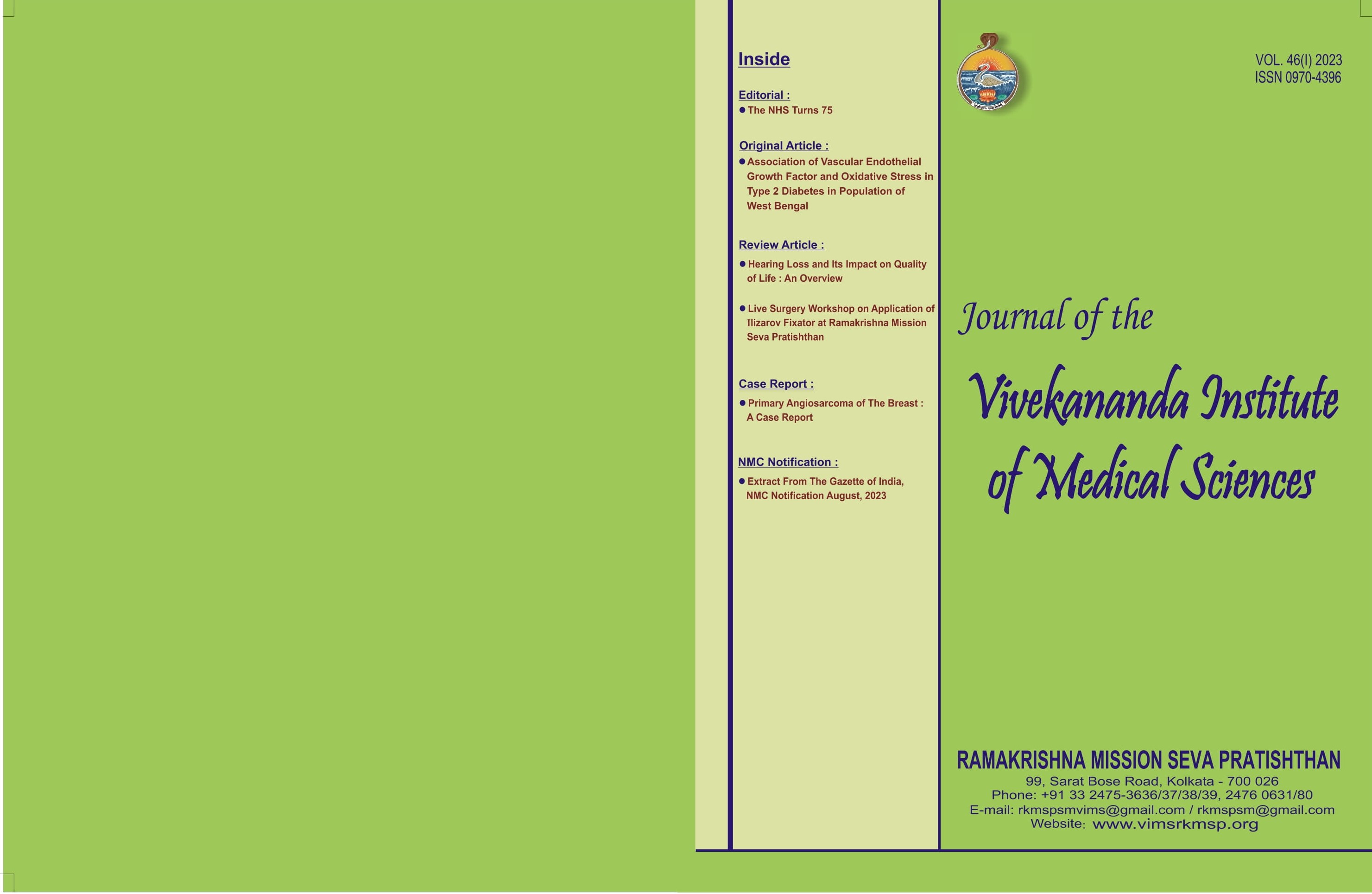
Association of Vascular Endothelial Growth Factor and Oxidative Stress in Type 2 Diabetes in Population of West Bengal

PDF

Published: June, 2023

Keywords: Type 2 Diabetes Mellitus, Reactive Oxygen Species, Vascular Endothelial Growth Factor

Author
  • Priyanka Biswas
  • Anumoy Mukherje
  • Baidyanath Pal
  • Debasish Maji
  • Madhusnata De
Abstract

Type 2 Diabetes Mellitus (T2DM), the most frequent subtype of diabetes, comprises a complex heterogeneous group of metabolic diseases characterized by high levels of blood glucose (hyperglycaemia) and impaired insulin action and/or insulin secretion due to � cell dysfunction. Increasing evidence in both experimental and clinical studies suggest oxidative stress (OS) plays a major role in the pathogenesis of T2DM and its complications. In a physiological condition appropriate levels of Reactive Oxygen Species (ROS), generated either in restricted amounts or in a transient fashion, are essentially required to promote physiological angiogenesis and homeostatic maintenance of healthy vasculature. Uncontrolled continuous ROS production ultimately contribute to pathology and causes tissue damage. One of the most important proangiogenic factors is Vascular Endothelial Growth Factor (VEGF) which plays 

a key role in diabetic endothelial dysfunction, which ultimately leads to pathogenesis of vascular complications. Therefore, we aimed to investigate the association between antioxidant status and VEGF levels in plasma that may lead to vascular complications. A case-control study of one hundred and fourteen patients with T2DM (n=ll4) and thirty three control subjects (n=33) were screened from different areas of West

 which gives rise to a risk o

damage (retinopathy, nephropathy and neuropathy) [Orasanu et al., 2009]. It is associated with reduced life expectancy, significant morbidity due to specific diabetes related microvascular complications, increased risk of macrovascular complications (ischaemic heart disease, stroke and peripheral vascular disease), and diminished quality of life [WHO, 2016].

According to the Diabetes Atlas (7th edition), the global prevalence of diabetes is estimated at 415 million (8.8%), which is expected to rise to 642 million in next 25 years [IDF, 2015]. India is being referred to as the 'diabetic capital of the world' [Joshi et al., 2012]. About 31% of the population of West Bengal is suffering from T2DM [Shashank et al., 2012]. Factors associated with the pathogenesis of long-term diabetic complications are multifactorial, although persistent hyperglycemia (glucotoxicity) seems to be a key mediator. At least three distinct metabolic pathways seem to be involved in the pathogenesis of long-term complications; it is likely that all of them play a role in a tissue­ specific manner [Kumar et al., 2018]. The main consequences of these pathways lead to the formation of oxidative stress (OS) which appears to be the major underlying cause of diabetic complications.

OS-dependent angiogenesis is an important contributor to the progression of cancers and chronic diseases. One of the most important proangiogenic factors is Vascular Endothelial Growth Factor (VEGF). OS induces the over expression of the VEGF gene in T2DM and leads to the development oflate diabetic complications.

In this study, the relationship between the VEGF level in plasma and stress level [level of malondialdehyde (lipid peroxidation) and activity of superoxide dismutase, catalase and glutathione peroxidase] were examined. To the best of our knowledge, no previous study was found in the literature which sought to investigate the relationship between VEGF expression and antioxidant status in the context of T2DM and its complications in the population of West Bengal. Therefore, we aimed to investigate the association between antioxidant status and VEGF

 level in plasma that may lead to vascular complications.


Reference
  1. Orasanu G, Plutzky J. The pathologic continuum of diabetic vascular disease. J Am Coll Cardiol. 2009; 53(5 Suppl) : S35-42.
  2. World Health Organization. Global report on diabetes. 2016. Accessed 30 August 2016. ISBN 978 - 92 - 4 -156525 7 (NLM classification: WK 810).
  3. International Diabetes Federation. IDF Atlas. 7th edition. [Last accessed on 2015 Dec 27]. Available from: http://www.diabetesatlas.org.
  4. Joshi AR, Pranita A, Phadke AV. Diabesity: curse of development. Int J Med. 2012;12:77-78.
  5. Shashank RJ, Banshi S, Muruga V. et al. Prevalence of diagnosed and undiagnosed diabetes and hypertension in India - results from the Screening India's Twin Epidemic (SITE) study. Diabetes Technol Ther. 2012; 12(1):8-15.
  6. Kumar, Abbas, Aster. Robbins Basic Paathology, I 0th ed. Elsevier;  2018. ISBN: 978-0-323-35317-5; International  Edition:  978-0-323-48054-3.
  7. Ohkawa H, Ohishi N, Yagi K.1979. Assay for lipid peroxides in animal tissues by thiobarbituric acid reaction. Anal Biochem., 95: 351-358.
  8. Kakkar P., Das B., Viswanathan P N. A modified spectrophotometric assay of SOD. Indian Journal of Biochem Biophys.,1984;21:130-2
  9. MagnaniL, GaydouM, Jean CH. 2000. Spectrophotometric measurement of antioxidant properties offlavones and flavonols against superoxide anion. Anal.Chim.Acta, 411(1-2) 1: 209-216.
  10. Sinha KA. Colorimetric assay of catalase. Anal. Biochem. 1972; 47: 389-394.
  11. Paglia DE, Valentine WN. 1967. Studies on the quantitative and qualitative characterization of erythrocyte glutathione peroxidase. J Lab Clin Med.,70: 158-69.
  12. Kumar, Abbas, Aster. Robbins Basic Paathology, 10th ed. Elsevier;  2018. ISBN: 978-0-323-35317-5; International Edition: 978-0-323-48054-3.
  13. Brownlee M.Glycation and diabetic complications. Diabetes. 1994; 43:836-841.
  14. Tiwari BK., Pandey KB, Abidi AB, Rizvi SI. Markers of Oxidative Stress during Diabetes Mellitus. 2013. Journal of Biomarkers. Article ID 378790. http://dx.doi.org/10.1155/2013/378790.
  15. Asmat, U., Abad, K. and Ismail, K. Diabetes mellitus and oxidative stress - A concise review. 2016. Saudi Pharmaceutical   Journal;24(5),   pp.547-553.
  16. Chandrika R., Sanjana R., Kishan Prasad HL., Vidya B. Catalase and malondialdehyde levels possible markers for type 2 diabetes mellitus. 2017. European Journal of Biomedical and Pharmaceutical sciences; 4(3):232-237.
  17. Rahbani-Nobar ME., Rahimi-Pour A., Rahbani-Nobar M. Total antioxidant capacity, superoxide dismutase and glutathione peroxidase in diabetic patients.1999. Medical Journal of Islamic Academy of Sciences; 12(4):109-114.
  18. Aaseth J., Stoe-Birketvedt G. Trace elements in human health and diseases: an update glutathione in overweight patients with poorly controlled diabetes type 2. 2000. The Journal of Trace Elements in Experimental Medicine; 13:105-111.
  19. Gonzalez de VR., Fernandez-Sanchez ML., Fernandez JC., Alvarez Menendez FY., Sanz-Medel A. Selenium levels and Glutathione peroxidase activity in the plasma of patients with type II diabetes mellitus.2016. J Trace Elem Med Biol; 37:44-49. doi: 10.1016/j.jtemb. 2016.06.007.
  20. Ines G., Elhadj-Ahmed K. Trace Elements Modulates Oxidative Stress in Type 2 Diabetes. 2017. Diabetes Food     Plan.doi:10.5772/intechopen.71172.
  21. Gawlik K., Naskalski JW., Fedak D., Pawlica-Gosiewska D., Grudzien U., Dumnicka P, Malecki MT., SolnicaB. Markers of Antioxidant Defense in Patients with Type 2 Diabetes. 2016. Oxidative Medicine and Cellular Longevity. Article ID 2352361. http://dx.doi.org/l 0.1155/2016/2352361.